

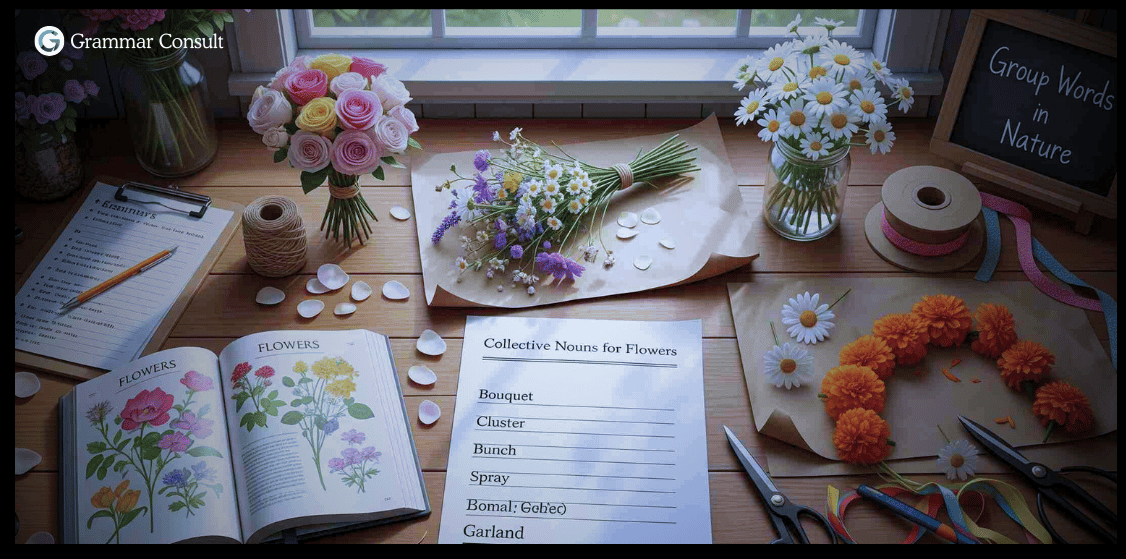
Have you ever paused to admire a bunch of blooming flowers and wondered what to call a group of them? You are not alone! In English, collective nouns for flowers are special words that describe a group of individual flowers, blossoms, or plant parts. These terms help us talk more vividly and accurately about nature’s floral displays. Whether you are a student, teacher, writer, or flower enthusiast, understanding flower collective nouns adds richness to your language and appreciation of the natural world.
Today, I will guide you through the fascinating world of flower collective nouns, what they are, why they matter, and how to use them correctly. Plus, I will share useful tips, common mistakes to avoid, and fun practice exercises to sharpen your skills. Let’s dive into this colorful aspect of English grammar!
What Are Collective Nouns for Flowers?
Imagine walking through a garden filled with various flowers, roses, daisies, tulips, lilies. Now, instead of simply saying “a lot of flowers,” you can use a specific word that refers to the entire group. These words are called collective nouns.
Definition:
- Collective nouns are words that represent a group of individuals or things as a single entity.
For example:
- “A bouquet of roses”
- “A bed of tulips”
- “A cluster of daisies”
In the context of flowers, collective nouns often describe groups of similar flowers or plant parts that grow together naturally or artificially.
Why Are Flower Collective Nouns Important?
Using collective nouns enriches your communication, making it more precise and vivid. It adds a poetic or descriptive touch, especially in writing about nature or gardening. Plus, mastering these words can impress teachers, clients, or friends who love botany or poetry.
Key Benefits:
- Enhances description quality
- Reduces repetitive language
- Adds clarity and specificity
- Stimulates imagination and appreciation of nature’s beauty
Exploring Common Flower Collective Nouns
While some floral collective nouns are well-known, many are less common but equally intriguing. I have organized a comprehensive list with definitions, examples, and usage tips.
Top Flower Collective Nouns with Definitions and Examples
Here’s a detailed table to help you understand and remember the most common flower collective nouns:
| Collective Noun | Definition | Typical Flowers or Contexts | Example Sentence |
|---|---|---|---|
| Bouquet | A bunch of flowers arranged together | Roses, tulips, daisies | She received a beautiful bouquet of lilies. |
| Bed | A cultivated patch of flowers growing together | Tulips, daffodils | The early spring bed of crocuses is breathtaking. |
| Cluster | A group of flowers growing closely together | Daisies, hyacinths | A cluster of bluebells covered the forest floor. |
| Spray | A small, delicate bunch of flowers | Orchids, sweet peas | The garden was filled with sprays of azaleas. |
| Corolla | Entire petals of a flower considered collectively | Roses, cherry blossoms | The cherry blossom’s delicate corolla fluttered in the breeze. |
| Inflorescence | The arrangement of multiple flowers on a stem | Sunflowers, hydrangeas | The sunflower’s inflorescence was large and bright. |
| Floret | Individual small flowers within a cluster | Grasses, daisies | Each floret in the sunflower center was tiny but vibrant. |
| Corymb | A flat-topped cluster of flowers | Elderflowers | Elderflowers bloom in a flat corymb shape. |
| Panicle | A branched cluster of flowers on a main stem | Lilacs, mountain laurel | The lilacs formed a fragrant panicle. |
| Umbel | A flower cluster where all stalks originate from one point | Queen Anne’s lace | A delicate umbel of umbellifers dotted the field. |
| Inflorescence | The complete arrangement of flowers on a stem | Orchids, foxgloves | The inflorescence of foxgloves towers over the garden. |
| Raceme | An unbranched cluster with flowers on stalks | Lilies, snapdragons | The lilies’ racemes stood tall in the sun. |
| Cyme | A flat-topped or rounded flower cluster | Spiraea, elder | The spiraea in full bloom formed a lovely cyme. |
| Cordon | A linear arrangement of flowers | Cherry trees | The cherry trees’ corden was bursting with pink blossoms. |
| Flock | A poetic term for a group of flowers or blossoms | Wildflowers, bridal bouquets | A flock of wildflowers swayed in the breeze. |
More Categories of Floral Collective Nouns
Beyond simple groups, flowers are often described using noun phrases that reflect their roles or personalities:
| Category | Example | Description | Usage Sample |
|---|---|---|---|
| Personality Traits | Graceful, Robust | Describes the nature of the flower group | A robust bed of marigolds |
| Physical Descriptions | Vast, Dense | Depicts size or density | A dense canopy of tropical flowers |
| Roles or Functions | Feed, Decorate | Explains why or how flowers are used | A bouquet of gifts |
| Colors | Patch, Spectrum | Focus on color variety | A spectrum of violets |
| Seasonal Groups | Spring bloom, Fall display | When flowers appear | A spring bloom of tulips |
| Symbolic or Cultural Terms | Herald, Embrace | Cultural significance | A bouquet of mourning lilies |
Using Multiple Collective Nouns in a Sentence
When describing a garden scene, it’s common to combine different group words. Here’s how you can do that correctly:
- Example: The garden was alive with a cluster of daisies, a bed of tulips, and sprays of hyacinths.
Tip: Use commas to separate different collective nouns, and ensure their descriptors match the context.
Different Forms of Collective Nouns with Examples
Collective nouns can be used in various grammatical forms:
| Form | Use | Example |
|---|---|---|
| Singular | As a singular entity | The bouquet is beautiful. |
| Plural | When emphasizing individual parts | The bouquets are arranged by the florist. |
| Countable/Uncountable | Depends on the noun | A sprig of mint (countable). The fragrance of flowers (uncountable). |
Note: Most flower collective nouns are treated as singular unless the emphasis is on individual elements.
Practice Exercises to Boost Your Skills
1. Fill-in-the-blank
Fill the blanks with the correct collective noun:
- She received a beautiful __________ of roses.
- The garden was dotted with a __________ of daisies.
- A __________ of chrysanthemums filled the room.
2. Error Correction
Identify and correct the mistake:
There was a flock of tulip in the garden.
3. Category Matching
Match the collective noun with its category:
a) Umbel
b) Bed of tulips
c) Floret
d) Inflorescence
- Arrangement of flowers on a stem
- Large group of flowers in a garden bed
- Small individual flower
- Specific flower cluster type
Answers:
a-1, b-2, c-3, d-4
Tips for Success with Flower Collective Nouns
- Visualize: Picture the flower group to pick the best noun.
- Be precise: Use the most accurate collective noun based on the shape or arrangement.
- Combine wisely: Mix nouns skillfully for more descriptive writing.
- Practice regularly: Use exercises to memorize and use these terms confidently.
- Read nature texts: Notice how writers describe flower groups in poetry and essays.
Common Mistakes & How to Avoid Them
| Mistake | Correction | Tip |
|---|---|---|
| Using plural verbs with singular collective nouns | Use singular verbs (e.g., The bouquet is not are) | Always check whether the noun is singular or plural before choosing the verb |
| Confusing different types of flower groups | Match the noun with the appropriate flower or arrangement | Review definitions and examples regularly |
| Overusing general terms like “flowers” instead of specific group nouns | Use specific collective nouns for vivid descriptions | Keep a list handy for quick reference |
Similar Variations and Creative Uses
- Combine different collective nouns for poetic effect: A cluster of blooms and a bed of petals.
- Use metaphors: The garden was a rainbow of flower groups.
- Personify flowers: The daisies danced in the breeze.
Why Using Flower Collective Nouns Matters
From poetry to gardening manuals, knowing how to describe flowers accurately makes your language richer and more engaging. It demonstrates attentiveness to detail and a love for nature. Plus, it can elevate your writing, helping others see the flowers, and words, in a new light.
Wrapping Up
So there you have it, a detailed guide to flower collective nouns, their importance, and how to master their use. The next time you are in a garden or writing about flowers, remember these terms to add vividness and precision. Practice regularly, avoid common mistakes, and enjoy describing nature’s beauty with flair!
Happy flower naming! Keep exploring, and soon you’ll be fluent in the language of blooms.
Keywords: Flower collective nouns, group words for flowers, types of flower groups, garden descriptions, botanical terms
Remember: The beauty of flowers is not just in their color but also in how we talk about them. Use these collective nouns to make your descriptions blossom!
